Read Part One free
The World That Was
All of Part One of Burrow’s End: 8 chapters and 10,891 words, from the first scout of the morning to the word that sends them west. Chapter One is read aloud, too.
The count: 30
Hear Chapter One
The audiobook’s first chapter. It plays only when you press play; the text follows below, at your own pace.
Chapter 1: The Morning Scout
The earth held its breath.
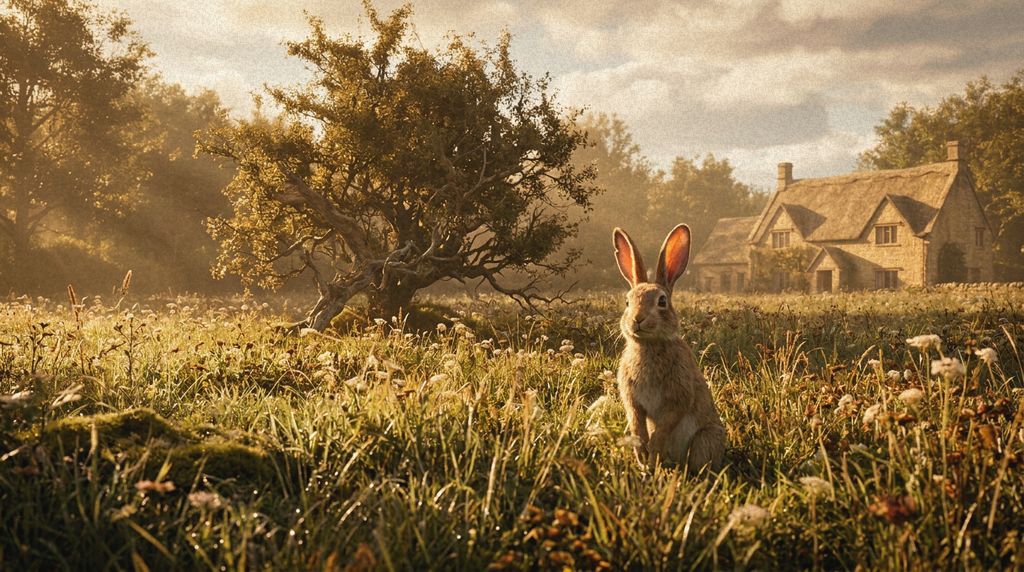
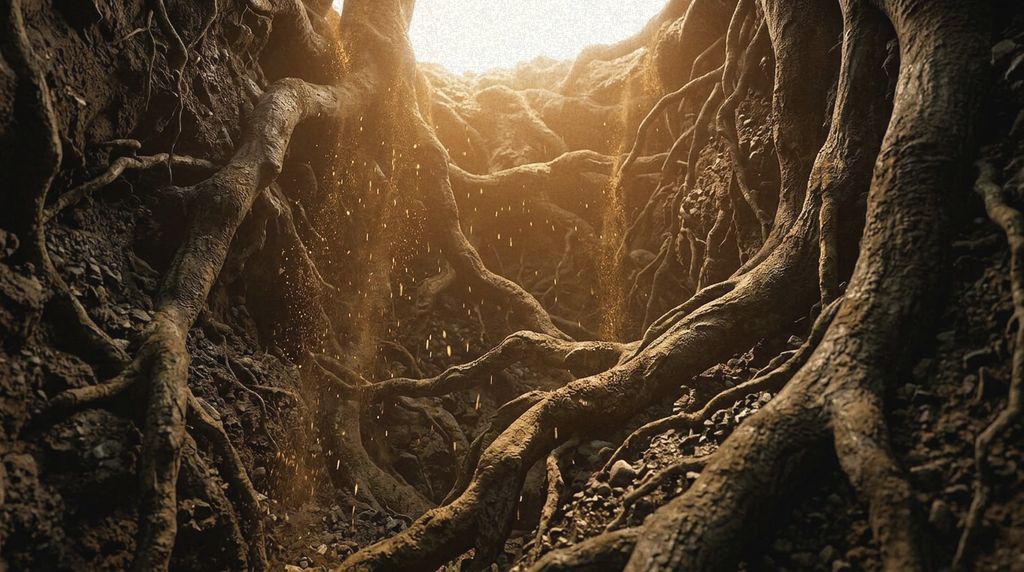
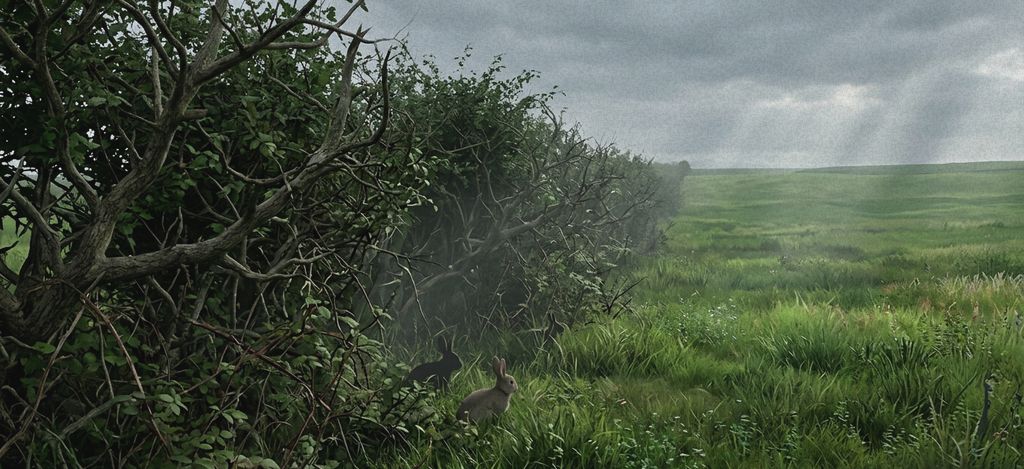
Fern lay in her sleeping chamber with her eyes half-open, suspended in that thin membrane between rest and readiness that was the only kind of sleep a scout ever truly knew. The darkness around her was not the darkness of nothing — it was the darkness of home. Warm chalk pressed close on three sides, smoothed by generations of fur. The ceiling curved overhead, laced with the fine hair-roots of the hawthorn that grew above, each tendril filtering a memory of daylight into the faintest amber suggestion. The air tasted of dried thyme and the mineral sweetness of chalk dust and the warm exhalations of thirty-odd sleeping bodies packed into their chambers throughout the warren.
She listened. Not with her ears alone — with her whole body. The earth transmitted its messages through bone and belly: the distant thrum of water moving through limestone aquifers far below, the faint scritch of beetle legs on packed soil, the deep rhythmic pulse of the warren itself, which was only the collective breathing of her kin but which sounded, in the pre-dawn stillness, like the heartbeat of something vast and ancient.
Nothing wrong. Nothing out of place.
She rose. The motion was efficient — a contraction of her hind legs beneath her, a press upward, a settling of weight onto all fours. No stretching. No lingering. The morning scout waited for no one and permitted no indulgence.
The tunnel to the main entrance was memorised in her muscles. She moved through it without sight, following the slight leftward curve, ducking beneath the low spot where a root crossed the ceiling at ear-height, stepping over the drainage channel that carried rainwater away from the sleeping chambers. Her whiskers mapped the walls, confirming distances. Her nose read the air — still, cool, carrying the green metallic scent of dew from somewhere above.
The entrance tunnel narrowed, then opened. The last stretch angled upward at forty degrees, and here the darkness changed. A grey luminescence filtered down from the world above — not yet dawn, but the promise of it. The air moved. Fresh. Cold. Carrying information.
Fern paused at the tunnel mouth.
This was the moment. The threshold between safety and exposure, between the known dark and the unknown light. Every morning of her life had included this moment, and every morning it required the same deliberate act of will: to push through the instinct that said stay, and choose the discipline that said go.
She went.
The hawthorn’s roots formed a cage around the entrance, and she emerged between them into the predawn meadow. The grass was grey-silver, heavy with dew. Each blade bowed under its burden of water, and where she brushed past, droplets cascaded down in cold showers that soaked her chest fur and belly. The air was vast after the close warmth of the warren — a shock of openness, of exposure, of sky.
Fern’s ears rose. They turned, independently, scanning separate arcs of the acoustic landscape. The left ear swept the hedgerow — blackbird alarm calls, or the absence of them. The right ear pointed toward the field’s eastern boundary, where the stone wall divided their meadow from the lane beyond. Both ears processed simultaneously, feeding her a composite map of the world’s intentions.
Birdsong. Layered by distance: a robin close, territorial, declaring ownership of the hawthorn’s upper branches. A woodlark ascending somewhere over the ridge, its song a falling spiral of notes. Skylarks — plural, impossible to count — somewhere high and getting higher. No alarm calls. No sudden silences. The birds were singing, which meant nothing was hunting.
She dropped her nose to the entrance soil. The scent story of the night unrolled beneath her: her own passage the evening before, old but familiar. Bracken’s musk, hours cold, from his midnight wandering that he thought she did not know about. And beneath those — fox. Old. Very old. Hours and hours, from sometime in the deep watches when only owls moved. The fox had passed along the hedgerow’s far side, moving east to west, and had not stopped. Not interested. Not this time.
Fern checked the hedge gap — the narrow break in the hawthorn where a larger predator might push through. The gap’s soil held no fresh prints. The dead leaves in its throat were undisturbed. She moved to the secondary entrance, twenty metres south, hidden beneath a tangle of blackthorn so dense that only a rabbit’s compressed body could navigate it. Clear.
She circled back to the main entrance. Sat upright. Drew the dawn air deep into her lungs through the complex architecture of her nasal passages, tasting it: damp grass, hawthorn blossom beginning to open, the mineral chalk of the exposed pathway along the ridge, distant sheep on the western slope, and — faintly, a trace so subtle it was almost memory — the petrochemical tang of the lane beyond the stone wall. A car had passed in the night. Nothing unusual.
She scanned the sky. The grey was lightening. No shapes moved against it. No wings. No glide-patterns cutting across the dawn. The sky was empty except for the ascending larks, too small and too high to concern her.
All clear.
Fern brought her right hind leg down on the packed earth of the entrance mound. The thump was solid, resonant, carrying the specific frequency that meant safe rather than danger. The distinction was subtle — a danger-thump was harder, faster, a staccato burst. This was a single measured strike. The vibration penetrated the earth, spreading through the warren’s tunnels like a stone dropped in still water.
Below her, bodies stirred. The warren was waking.
They emerged in ones and twos, blinking against the brightening light. A doe nosed out cautiously, tested the air, and then committed fully, flowing from the entrance in a single liquid motion. Behind her, a yearling — nearly grown, still gangly in the hind legs — scrambled up the entrance slope with more enthusiasm than grace, sneezed explosively as the dew-damp air hit his nostrils, and startled himself so completely that he leapt sideways into the blackthorn.
Two does emerged together, pressed flank to flank, and immediately began grooming each other’s ears with the unhurried intimacy of long companionship. An old buck stretched — each hind leg extended fully behind him in turn, claws spread, a luxurious full-body extension that made him seem twice his resting length — and then settled into a comfortable crouch and began methodically consuming the nearest clover patch.
The meadow filled. Twenty. Twenty-five. Thirty rabbits, spreading across the grass in the pattern of their species — family clusters facing outward, yearlings near the centre where the older rabbits’ vigilance protected them, does with nursing kits staying close to the entrance for quick retreat. One sentinel sat upright on the entrance mound, ears high, the designated watcher while others ate.
Fern remained at the meadow’s edge, positioned between the hawthorn and the hedge gap. She ate — the grass was sweet and dense with the night’s moisture — but she faced outward. Always outward. Her ears never stopped their independent rotation. She chewed in a steady rhythm that disguised the constant alertness of her posture. To a casual observer she was simply a rabbit eating grass. To anyone who understood what they were looking at, she was a perimeter.
The light was changing. The grey was burning off, replaced by the first golden rays cresting the eastern ridge. Where the sun touched the dew, the meadow caught fire — not with heat but with refracted light, each droplet a tiny prism throwing colour into the morning air. Buttercups blazed. The red campion along the hedge base glowed like embers. A bumblebee, fat and purposeful, droned past Fern’s left ear and disappeared into the clover.
The world was perfect. It was always perfect, in the mornings, before anything had time to go wrong.
Chapter 2: The Warren
Fern descended.
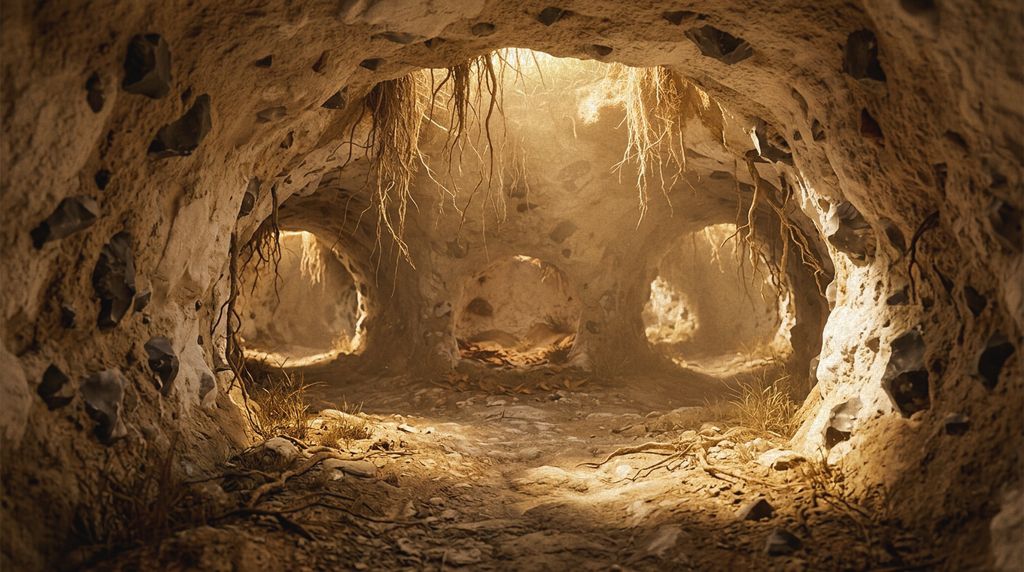
The transition from surface to underground was immediate and absolute — from the vast openness of the meadow into the close, warm compression of earth. Light fell away in stages: the bright entrance, then the filtered amber of the first curve, then the soft brown darkness of the deep tunnels. Her other senses expanded to fill the space that sight had vacated. The texture of packed chalk beneath her paws, slightly damp from the night’s condensation. The smell — intensely familiar, layered with the musk of family, the sweetness of stored herbs, the chalky mineral base note that was the warren itself. The sound changed too: the open layered soundscape of the surface collapsed into the intimate acoustics of enclosed earth, where every scuffle and breath was close and warm and immediate.
She moved through the main passage, which curved gently leftward following a natural seam in the chalk. The tunnel was wide enough for two rabbits to pass — barely — and its ceiling was reinforced by a lattice of hawthorn roots that had, over generations, grown to embrace the tunnel’s shape. Where the roots crossed, they formed natural arches that caught and held the faintest trace of surface light, so that the passage was never entirely dark.
The nursery chamber opened to her right. Five kits lay in a pile so thoroughly intertwined that it was impossible to determine where one ended and another began. Tiny ears. Tiny paws. The occasional tail, twitching in sleep. The whole mass rose and fell with a shared breathing rhythm. A doe — their mother — lay curled around the perimeter of the pile, one eye open, watching Fern pass with the calm alertness of a parent who sleeps with half her brain awake. Fern dipped her nose in passing. A greeting. A reassurance. The doe’s eye closed again.
Further along, a side chamber opened into the warren’s food stores. Dried clover packed into alcoves in the chalk, wild thyme hanging in bundles from root-hooks in the ceiling, the last of winter’s chamomile stored in a shallow depression lined with dry grass. The engineering was old and proven: a ventilation shaft, no wider than a rabbit’s paw, angled upward to the secondary entrance, drawing fresh air through the stores and preventing mould. A drainage channel, shallow but precise, ran along the tunnel floor and carried moisture toward the lower levels where it seeped back into the chalk.
Fern passed the stores and followed the passage as it branched — left toward the sleeping chambers, right toward the main hall. She took the left.
Bracken’s chamber was easy to identify even in near-darkness: it was the one that generated noise. His voice reached her before she reached him, resonant with the particular warmth that meant he was performing.
“—and the stoat was THIS close. Closer than you. Closer than — come here, let me show you — THAT close. I could smell its breath. And I have to tell you, as breath goes, truly horrific. Like something had died in its mouth and then a second thing had died in there to keep the first thing company—”
Fern rounded the chamber’s entrance. Five yearlings sat in a half-circle around Bracken, their eyes enormous, their ears pressed forward. Bracken occupied the centre of the space with the natural ease of a rabbit who had never in his life felt uncertain about where to put himself. He was larger than Fern — broader in the shoulder, warmer in the fur, built with the generous proportions of a buck who ate when he was hungry rather than when it was safe. His whole body was the story: ears flat for the stoat’s approach, eyes wide for the terror, body coiled for the dramatic escape.
“—and I thought, right, this is it. This is how it ends. Not in the meadow. Not at home. Here, in a ditch, with a creature whose dental hygiene is an actual crime against—”
“You didn’t outrun a stoat, Bracken.”
The yearlings’ heads swivelled toward Fern in the entrance. Bracken’s ears popped upright.
“You hid behind a stone wall and it lost interest,” Fern said.
The yearlings deflated visibly — ears softening, bodies settling from the forward lean of rapt attention into the slump of anticlimax.
Bracken held the silence for one beat. Two. His expression was pure wounded dignity.
“I was getting to that part.”
“That’s the only part.”
She moved on before he could respond. But his voice followed her down the passage, conspiratorial now, pitched for the yearlings alone: “She was there, but she was hiding behind a different stone wall, so her perspective is — at best — partial.”
The yearlings’ ears pricked back up. Fern felt the smallest twitch at the corner of her mouth. She did not let it become a smile.
Nettle’s tunnel was a dead-end branch off the main passage, narrow enough that a larger rabbit might have trouble turning around in it. This was by design. Nettle had chosen it for its privacy and its chalk — the walls here were smooth and pale, ideal for scratching.
He sat with his back to the entrance, his forepaws working against the wall with precise, deliberate strokes. Fern paused at the entrance and watched him for a moment. The map was growing. Routes to water sources, marked with a symbol that looked like three rippling lines. Bolt holes, marked with a circle. Predator territories — fox runs, badger setts — marked with angular slashes. The whole western territory of the warren’s range, inscribed in a personal notation system that only Nettle could read.
His right hind leg was tucked beneath him at its characteristic angle — shorter than the left, twisted inward at the joint, a condition he had been born with and that he accommodated so naturally that it was simply how Nettle looked. When he sat, he leaned slightly to the left. When he hopped, his gait was asymmetric — a distinctive rhythm that Fern could identify from two tunnels away. He never mentioned it. Neither did anyone else, except the yearlings who sometimes asked and received a look so withering that they never asked again.
“Three new exits mapped on the south side,” Nettle said without turning around. His voice was flat and precise, the voice of a rabbit who measured his words the way he measured distances. “The chalk’s soft there. Easy digging if we need them.”
“Anything unusual?”
“A new mole tunnel intersecting at the forty-metre mark. I’ll reroute around it. The mole’s heading north-east — probably following a worm seam. No threat, but I don’t want our tunnels crossing unless it’s on our terms.”
He did not look up. She did not stop. The exchange was complete — all the information it needed to contain, contained. They had been friends long enough that conversation between them had been refined to its essential elements.
The deepest chamber was the oldest part of the warren, where the chalk was darkest — aged to a deep amber-cream by centuries of contact with root-tannins and mineral water. The roots here were thick as a rabbit’s body, ancient hawthorn roots that had grown into and around the chamber walls until they were structural, holding the ceiling in place with the patient strength of living wood.
Thistle sat at the chamber’s centre. She was small — she had always been small, even in her youth, and age had compressed her further. Her fur was grey with patches of white around her muzzle and the base of her ears, and she carried the particular thinness of a rabbit who had lived beyond the age when fat accumulates easily. But her eyes were bright and clear and dark, missing nothing, and her voice — when she used it — carried a weight that had nothing to do with volume.
She was using it now. Singing, low and rhythmic, in a cadence that rose and fell like breathing.
Long Ear found the meadow
when the grass was taller than the sky,
and she dug with her claws
and she dug with her heart
and she said: this is where we will not die.
Five kits surrounded her — not the nursery kits, these were older, just old enough to sit upright and listen, just young enough to be hypnotised by the rhythm of a voice that had been telling stories since before their mothers were born. Their eyes were glazed with the particular bliss of young creatures being sung to. One was already asleep, its head resting on its neighbour’s haunch.
The song continued, dropping in volume until it was barely more than a murmur. Thistle’s paws made small gestures as she sang — shaping the air, drawing the story into physical space. The founding song. The song about how this place began. The song that said: we belong here. We have always belonged here. The earth itself invited us.
Fern lingered at the chamber entrance, listening. She had heard this song hundreds of times. Thousands. It was woven into the fabric of her earliest memories — Thistle’s voice in the dark, the warmth of the kit-pile, the absolute security of a world that began and ended at the warren’s walls.
The song was beautiful. It was also, Fern suspected, largely untrue. But untrue and useless were not the same thing, and she had never said so to Thistle. The song held them together. That was enough.
The main hall was the warren’s heart — the largest chamber, positioned where three primary tunnels converged. It had been dug in stages over generations, each successive warren-chief widening it slightly, smoothing its walls, reinforcing its ceiling with additional root-channels. The result was a space that could hold the entire community in a comfortable press of bodies. The ceiling was higher here than anywhere else in the warren — nearly three rabbit-heights — and a single ventilation shaft angled up toward the surface, allowing a thread of daylight to enter and touch the chamber floor like a finger pointing downward.
Elder Moss sat beneath that finger of light. He was old, his fur the particular grey-green that gave him his name, and he was thick through the body with the satisfied solidity of a rabbit who had led well and eaten well for many seasons. His eyes were half-closed, but his ears were upright, and he tracked the movement of rabbits through his hall with the contentment of a keeper watching his garden grow.
Fern approached. Their exchange was ritual — unchanged for as long as she had been scout.
“Safe morning?”
“Safe morning, Elder.”
His eyes opened fully. Warm. Calm. Certain in a way that Fern found both reassuring and, lately, slightly troubling.
“The kits?”
“Growing fast. Sorrel’s nearly as big as her mother.”
“Her mother was never big.” His whiskers twitched — amusement, affection, the pleasure of continuity. “Go eat, Fern. The meadow is generous today.”
She dipped her nose — the formal acknowledgement of a scout to a chief — and turned toward the exit. As she passed through the main hall, she caught movement at the tunnel entrance nearest the surface. Clover, pale and cream-furred, was grooming her chest with quick nervous strokes, her eyes fixed on the grey suggestion of daylight above.
A shadow crossed the tunnel mouth — some bird above, passing over the entrance.
Clover startled so violently that she hit the tunnel wall with an audible thump of bone on chalk.
Bracken’s voice, from somewhere down the passage: “It’s a cloud, Clover.”
“I know it’s a cloud.” Clover’s voice was slightly too high, slightly too fast. She resumed grooming, her paws working at her chest fur with increased intensity.
She had not known it was a cloud.
Fern passed without comment. Clover’s fear was not laziness or weakness — it was honest. It was the survival response doing exactly what evolution had designed it to do: keep the creature alive by assuming the worst. The difference between Clover and Fern was not that Fern felt no fear. It was that Fern had learned to think through it. To stand in the fear’s centre and still ask: what is this? What do I do?
Not every rabbit needed to do that. The warren needed Clovers too — rabbits whose quick terror sounded alarms that the calmer missed. The system only worked if there were many kinds of fear in it.
Fern ascended the entrance tunnel and emerged once more into the golden morning.

Chapter 3: Afternoon
The meadow in full sunlight was a country of warmth and abundance. The dew had evaporated into a faint mist that hung in the low places — the drainage ditch, the rabbit-runs through the long grass — and where the sun touched this mist, it turned to gold. The grass moved in slow waves, responding to a breeze that came from the south-west and carried the smell of distant rain that would not arrive until evening.
Thirty rabbits grazed in the pattern of their species. Family clusters, facing outward. Does with young close to the entrance. Yearlings in a loose group near the centre, supervised by the simple geometry of adult attention. One rabbit on the mound — today it was a young buck named Sedge’s son, alert and proud of his responsibility — sat upright with ears high, scanning.
Fern grazed at the meadow’s western edge, where the grass met the first stones of the low wall that bounded their territory. She ate methodically, in neat rows, because that was how she had always eaten. The habit placed order on the world. It was a small comfort and she did not examine it.
Bracken appeared beside her. He did not arrive — he materialised, in the way of rabbits who move through long grass with the ease of water through reeds. He settled next to her, close enough that their flanks almost touched, and began eating with his characteristic carelessness — quick bites, barely chewed, his eyes wandering across the landscape as if the grass were merely a reason to be outside.
“There’s a whole world past that wall,” he said.
Fern’s ears did not turn toward him. She continued eating. “There’s a whole world of things that want to eat us past that wall.”
“Not everything. Not the hills. Thistle talks about the western hills — chalk downs, open country, clover that grows year-round.”
“Thistle talks about a lot of things. Some of them are even true.”
“You don’t believe in Briar Hill?”
She paused her eating. Sat up slightly. Her nose worked at the air — not because she was scenting anything, but because it was what she did when she was choosing words.
“I believe in this meadow. I believe in these tunnels. I believe in what I can scout and what I can check and what I can thump to warn about. Everything else is a story.”
“Stories are how we remember where to go.”
“Maps are how we remember where to go. Stories are how we remember where we’ve been. There’s a difference.”
Bracken turned toward her. His eyes were bright — not with argument but with something else. Something that looked, from the outside, like hunger. Not for food. For distance. For the feeling of ground he had never covered passing beneath him.
He opened his mouth.
Shadow.
The world changed. The quality of light shifted as if a hand had been laid over the sun — not darkness, exactly, but a dimming. A desaturation. Colours muting toward grey as something passed between the meadow and the sky.
Fern froze.
The freeze was not a choice. It was older than choice, older than thought, older than language itself. It was the deepest instruction written into her body: do not move. Do not breathe. Do not exist. Become nothing and the thing above will not see you.
Thirty rabbits froze. Every single one, simultaneously, in whatever posture they had occupied when the shadow passed. A yearling mid-leap, one hind leg extended behind her. A doe with her nose buried in clover, mouth open, a green stem hanging from her lips. The sentinel on the mound, already upright, now rigid as carved stone.
Silence. The birds had stopped singing. Even the insects pause. The only sound was the wind through the grass and, somewhere above, the whisper of broad wings adjusting to a thermal.
The shadow moved. It swept across the meadow from east to west, the shape of it clearly avian — long wings spread wide, the suggestion of a forked tail. A red kite, riding the afternoon air. Its silhouette crossed over the rabbits like a stain spreading across clean cloth.
Ten seconds. Fifteen. The shadow circled back. Closer this time — lower — and in the dark shape cast upon the grass, individual feathers were visible at the wing-tips, spread like fingers.
The kite banked. Rose. Caught an updraft above the ridge and climbed away, diminishing against the blue until it was a speck and then nothing.
The freeze broke.
It broke all at once, like a held breath released. The yearling completed her leap. The doe resumed chewing. The sentinel’s ears swivelled, tracking the kite’s departure with the focused attention of a creature that has just been reminded of its mortality.
Clover, somewhere behind Fern, exhaled so loudly and so shakily that three nearby rabbits flinched.
Bracken shook himself — a full-body shudder that rippled from ears to tail, shedding the freeze-tension from his muscles.
“See?” he said. “That’s what I mean. We spend our whole lives freezing.”
Fern’s eyes were still on the sky. Her ears tracked the space where the kite had been, confirming its absence, confirming the absence of anything else.
“We spend our whole lives alive,” she said.
A pause. The weight of it settled between them.
“Same thing, Fern.”
“No.” She went back to eating. Methodical. In rows. “It really isn’t.”
He watched her for a moment — his sister, nose down, taking neat bites in neat rows because the world was made slightly more bearable by order. Then he looked at the stone wall. At the hills beyond it, green and gold and endlessly rolling toward a western horizon he had never seen.
“Alive and frozen,” he murmured. “That’s not enough.”
Fern’s right ear turned toward him. One rotation. One moment of acknowledgement. Then it turned back to its post, scanning the hedge, the sky, the perimeter.
She had heard. She did not answer.
Nettle joined them some time later, emerging from the secondary entrance with his distinctive hop — left-right-left, the rhythm uneven but fast enough, always fast enough. He settled beside Fern and began selecting specific plants from the grass around him: wild thyme, preferentially, pulling it from its stems with the precision of a rabbit who knew what he wanted and saw no reason to eat anything else.
“Did I miss the hawk?” he asked.
“Kite,” Fern corrected. “And yes. By about a minute.”
“I always miss the hawk. The kite. Whatever it was. I’m beginning to think they avoid me specifically.”
“They don’t know you exist.”
“I choose to take that as a compliment to my camouflage.” He ate a strand of thyme with deliberate pleasure. “Also to my extremely low profile. Literally. I’m very close to the ground.”
This was the closest Nettle ever came to referencing his leg — obliquely, through humour, in a way that made it clear the topic was his to raise and no one else’s. Fern did not respond to it. She never did. It was one of the quiet pacts of their friendship: his body was his business, and their respect for each other lived in the space of things they did not need to say.
They grazed together as the afternoon deepened. Three rabbits eating in comfortable silence, their bodies forming a loose triangle — Fern facing west toward the wall, Bracken facing south toward the slope, Nettle facing east toward the entrance. Between them, a geometry of coverage. An unconscious arrangement that ensured nothing could approach from any direction without being seen.
Above them, the sun moved. The shadows lengthened. A cloud drifted across from the west and the meadow dimmed briefly, then blazed again as the sun returned. Somewhere in the distance, over the ridge, a tractor moved along a lane — its sound reaching them as a low mechanical drone, felt in the earth more than heard through the air.
The world was patient. The meadow was generous. The grass grew, and they ate, and the afternoon passed as afternoons had always passed in this place.
Chapter 4: Thistle’s Story
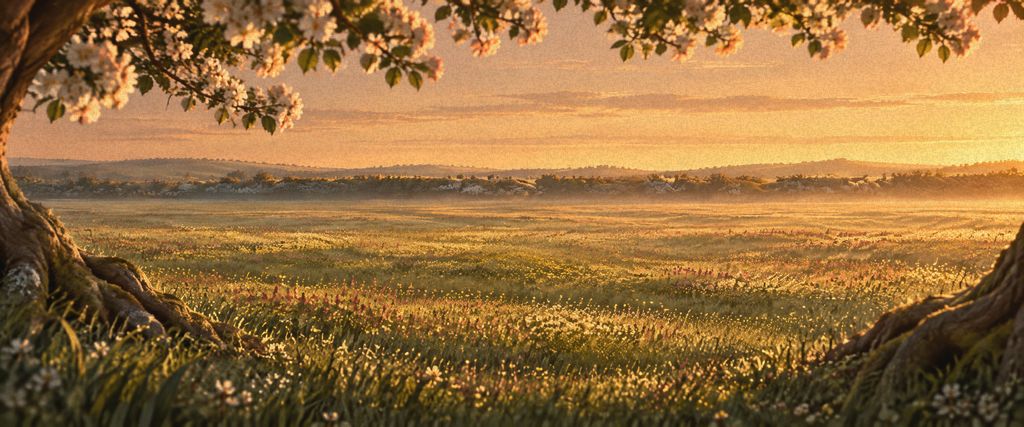
Evening came as a slow bronze flood across the hills. The light thickened, taking on colour and weight. The meadow’s greens deepened to emerald, then olive, then the near-black of grass in shadow. The sky turned — first gold, then amber, then the deep red-purple of a Cotswolds sunset in late spring. The hawthorn’s blossoms, which had been white all day, caught the last light and turned briefly pink.
The rabbits descended. One by one, then in clusters, they flowed back into the warren as the light failed. The sentinel was last — holding position until the final rabbit was underground, then following with a quick backward glance at the empty meadow. The owl-time was beginning. The rules above changed in the dark.
In the main hall, the warren gathered. The chamber filled with warm bodies pressing close — kits in the centre, yearlings around them, does and bucks at the perimeter. The light from the ventilation shaft had faded to almost nothing, but the darkness was not uncomfortable. It was intimate. Familiar. The darkness of a shared bed, of a place where every body was known and every breath expected.
Thistle took her position at the chamber’s focal point — the slight depression in the floor where the chalk was smoothest, worn by generations of storytellers who had sat in exactly this spot. She settled into the depression as if it had been carved for her. Perhaps it had.
She was silent for a moment. The warren’s breathing settled. Even the kits grew still, as if something in the air had changed — a frequency, a pressure, the particular quality of attention that precedes a story.
“Before the stone walls,” Thistle said.
Her voice was low and carried the cadence of something very old — a rhythm inherited rather than invented, passed from storyteller to storyteller like a flame passed between torches. It rose and fell in groups of three, each phrase slightly larger than the last.
“Before the metal roads. Before the lights that never go out.”
She had them. Even Bracken, who had heard this story a hundred times, leaned forward. Even the most cynical yearling felt the pull of Thistle’s voice when it entered this register.
“There was a rabbit called King Root. He was the strongest rabbit who ever lived, and the cleverest, and he had one eye that could see in the dark and one eye that could see into tomorrow.”
The kits’ eyes widened. One of them pressed closer to its mother’s flank, thrilled and frightened and unable to stop listening.
“King Root looked at the world and he saw what was coming. He saw the metal roads that would cut across every valley. He saw the lights that would burn all night until the stars went out. He saw the stone walls that men would build across every field and every hill until there was nowhere left for a rabbit to run.”
Thistle paused. The silence was absolute.
“And he said: I will find a place that the roads cannot reach and the lights cannot find and the walls cannot enclose.”
Her voice dropped lower, taking on the quality of a confession — something shared in confidence, something precious being handed from one generation to the next.
“He walked west. For seven days and seven nights. Past the river that drowns — where the water runs so fast that even stones cannot stand. Past the forest that swallows — where the trees grow so thick that daylight cannot enter. Past the hill that watches — where the slopes have eyes and the earth remembers everything that passes over it.”
The kits were motionless. Even the adults had stilled. The story was working its old magic — the magic of voice and rhythm and the ancient compact between teller and listener that says: give me your attention and I will give you a world.
“And on the seventh night, he found a hill of white chalk. The hill was honeycombed with tunnels that glowed with their own light — green and soft, like moonlight trapped in stone. The soil was deep. The clover grew year-round, even in the coldest winter. And no fox had ever set paw upon its slopes.”
Thistle’s voice was barely more than a whisper now, but it carried through the chamber with the clarity of a bell.
“He dug. He built. He made a warren that was a city, a kingdom, a world entire. Tunnels so wide that twenty rabbits could run abreast. Chambers so high that a rabbit standing on her hind legs could not touch the ceiling. Food stores so deep that no winter could ever empty them.”
She straightened slightly. Her voice rose for the final phrase — the invocation, the promise that had been passed down through more generations than anyone could count.
“And he said to all the rabbits of the earth: come. Come to Briar Hill. Where no rabbit ever has to run.”
Silence.
The story settled over the warren like a blanket. The kits were asleep — some of them, the youngest, had drifted off during the river-that-drowns. The older ones were suspended in that delicious space between sleep and waking where stories and dreams are the same substance.
Bracken’s eyes were shining. He stared at nothing — at the dark of the chamber wall, at the place where the story lived, at the western hills he had never seen. The story had done what stories always did to Bracken: it had made the world bigger. It had confirmed that there was more. More than this meadow. More than these tunnels. More than the stone wall and the hedge gap and the known routes and the morning scout.
Fern watched her brother’s face and felt the familiar tightness in her chest. Love and exasperation and something that might have been fear.
In his side tunnel — visible from the main hall if you knew where to look — Nettle had produced a small, precise mark on his wall. A directional notation. An arrow pointing west. Beside it, symbols: water. Ridge. Distance unknown. He was filing the information. Not believing it — filing it. There was a difference, and the difference mattered.
Fern caught his eye across the dim chamber. Her expression said: don’t encourage this.
Nettle’s expression, in so far as it was visible in the near-dark, said: I’m mapping, not believing. There’s a difference.
Elder Moss had not moved. He sat beneath the ventilation shaft, watching Thistle with an expression that Fern could not read. It might have been appreciation — the old respecting the ancient. It might have been concern — the leader hearing a story that could make his rabbits restless. It might have been recognition — something private and deep that lived between the two oldest rabbits in the warren and was no one else’s business.
The chamber settled. Bodies relaxed into sleeping positions. A kit whimpered briefly and was soothed by its mother’s grooming tongue. The main hall’s darkness deepened as the last trace of daylight left the ventilation shaft.
Thirty rabbits, warm and safe and whole, sleeping in the earth.

Chapter 5: The Tremor
Fern’s eyes opened.
She did not know what had woken her. The darkness of her sleeping chamber was absolute — the kind of dark that existed only underground, where no starlight penetrated and no moon could reach. The air was still and warm, tasting of chalk dust and sleeping fur.
She held motionless. Listened. Her ears turned in the dark, scanning frequencies.
Nothing. The soft breathing of the warren. Bracken’s slow exhalations from the adjacent chamber. The occasional rustle of a kit turning in its sleep.
Then she felt it. Not a sound. A vibration — deep, subsonic, felt in the belly and the jawbone rather than heard through the ears. The chalk around her hummed with it. A brief tremor that was there and then wasn’t, like a question asked and immediately retracted.
Dust drifted from the ceiling. A single pebble — chalk fragment, thumb-sized — rolled along the tunnel floor with a small rattling sound and came to rest against the wall.
Fern waited.
The vibration came again. Longer this time, and deeper — a bass frequency that rise from the bedrock itself. The tunnel walls resonated with it. The roots in the ceiling trembled, shedding ancient dust.
In the nursery chamber, a kit whimpered in its sleep.
Fern moved. Silent, fast, navigating the dark tunnels by memory and whisker-touch. Past Bracken’s chamber, where his breathing had changed — lighter, shallower. He was awake, or nearly so. Past the nursery, where the kit-pile shifted and resettled. Past Nettle’s side tunnel, where a single scratch of claw on chalk told her that he too had felt it and was awake and recording.
The entrance tunnel. The upward slope. The hawthorn roots. The threshold.
She emerged into the night.
The stars were bright — countless pinpricks in a clear sky, the Milky Way a pale river overhead. The moon was a thin crescent, low on the western horizon, providing almost no light. The meadow lay in darkness, every blade of grass a grey suggestion, every shadow a potential threat.
But at the field’s eastern edge — lights. Not stars. Not moonlight. Something else entirely. Hard white light, blazing from tall poles, cutting into the darkness with the sharp edges of human manufacture. The light was cold — a colour temperature that existed nowhere in the natural world, neither warm like sun nor cool like moon but something alien, something that belonged to a different physics.
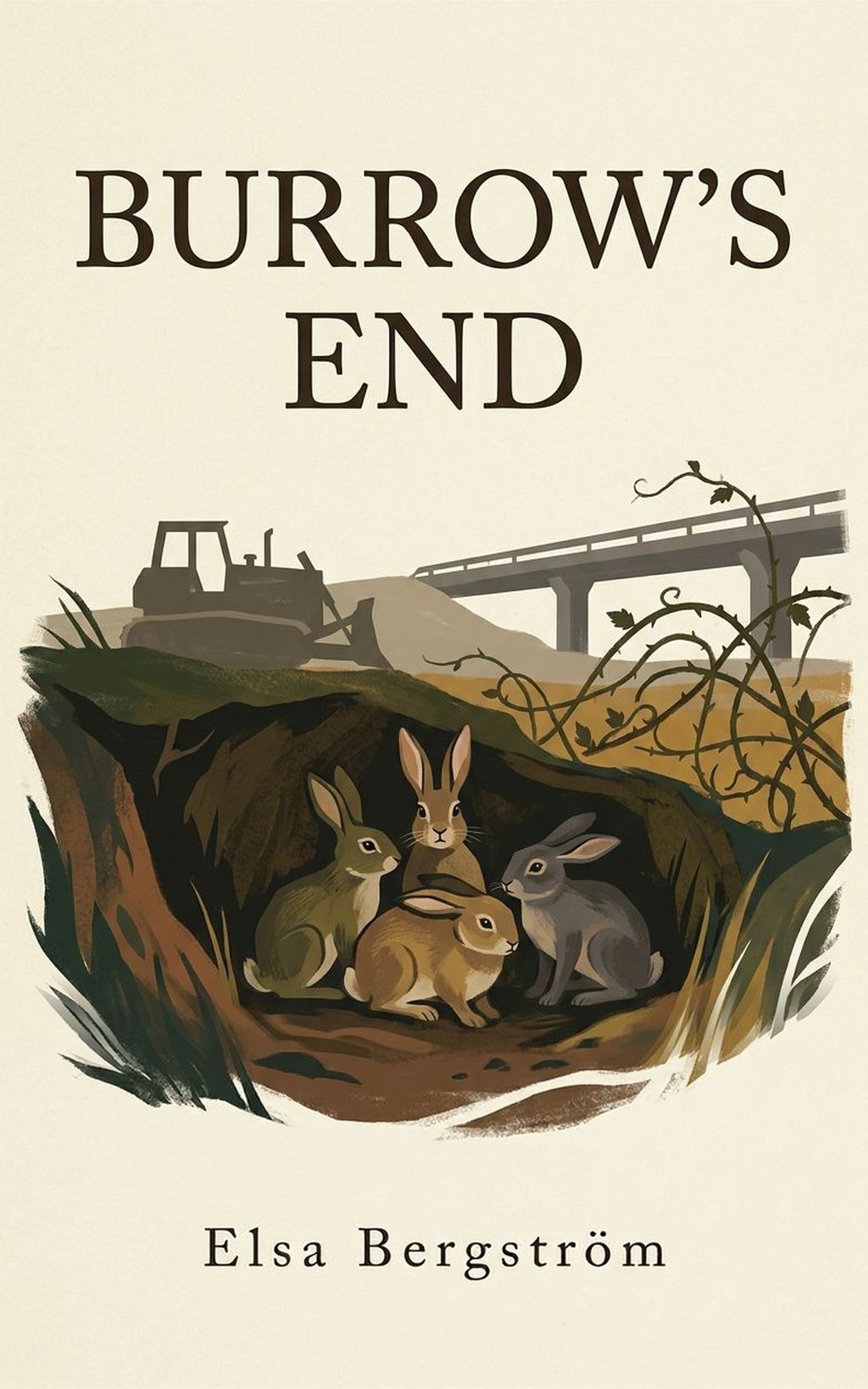
In that cold light, shapes. The silhouette of heavy machinery: a bulldozer, its blade raised like a jaw frozen mid-bite. An excavator, its arm extended against the glare, reaching into the sky like the limb of some mechanical predator at rest. A skip, half-full of earth and stone.
The machines were motionless. The lights were not for working — they were for watching. For presence. For making a claim on the dark.
Fern’s heart rate climbed. She could feel it — the rapid flutter at her throat, the slight tremor in her ear-tips that came with adrenaline. She forced herself still. Forced her eyes to examine rather than panic.
Flags.
Orange plastic flags on thin wire stakes. She had not seen them during the day — they must have been planted during the afternoon, while the warren grazed on the western side. Dozens of them. Rows of them. Neat geometric lines marching across the meadow with the precision of something measured and deliberate.
The lines followed the warren’s shape.
Not exactly — but close enough to tighten her chest. The main passage ran north-south. The flags ran north-south. The nursery was off to the eastern side. A cluster of flags marked the earth above it. The bolt hole to the south, the ventilation shaft to the north — flags. Flags on every one.
They knew. Somehow, the humans with their machines and their hard white lights knew where the warren was. They had found it without entering it, mapped it without digging.
Fern stared at the flags. The flags — bright orange, impossibly cheerful in the colourless night — stared back.
She returned underground. She lay in her sleeping chamber. She stared at the ceiling, where a fine coating of new dust had settled on the hawthorn roots.
She did not sleep.
Some time later — minutes or hours, it was impossible to tell in the unchanging dark — Bracken’s voice came from the adjacent chamber. Low. Quiet. Fully awake.
“They’re going to build here.”
Fern did not pretend surprise. “I know.”
“The lights. The machines. They’ve been there for days, haven’t they? I’ve seen the van at the eastern gate.”
“The planning department van. Nettle read the side panel.”
Silence. The vibration came again — faint, far away, a machine settling on its treads or a generator cycling or some other mechanical process that had nothing to do with rabbits and everything to do with what was coming.
“We should tell the others,” Bracken said.
“Elder Moss won’t listen. He’ll say the warren has survived everything. Foxes and floods and the long frost.”
“Then we tell him louder.”
“That’s not how it works, Bracken.”
“Maybe it should be.”
The silence that followed was filled with things neither of them knew how to say. The distance between recognising a danger and being able to do anything about it. The weight of knowing something terrible and being the only ones awake to know it.
They did not speak again. But neither slept.
Above them, through metres of chalk and soil and ancient hawthorn root, the construction lights blazed on through the night — patient, unwavering, announcing their ownership of the dark.

Chapter 6: The Flags
Morning came grey and thin. The dawn had none of the golden warmth that Fern associated with safe mornings — the sky was overcast, the light flat and directionless, and the dew on the grass had a cold metallic quality that made the meadow look like it was made of steel.
Fern’s scout was the same — hedge gap, scent check, sky scan — but the landscape had transformed overnight. The flags that had been dozens were now hundreds. They covered the meadow in a grid pattern, precise as graph paper, running from the machinery at the eastern edge all the way to the hedgerow on the western boundary. Between the flags, measuring tape had been stretched in straight lines. Spray paint — vivid orange, the colour of warning, the colour of poison berries — marked the grass in symbols Fern could not read but whose precision alone was enough to chill her.
At the eastern edge, the machines were larger in daylight than they had seemed at night. Three bulldozers, yellow as wasps, crouched on their treads. The excavator’s arm was folded now — lowered, retracted, resting. A skip loader sat beside a growing pile of earth that had been scraped from the lane. Humans moved among the machines — legs in high-visibility jackets, boots on the ground, voices carrying across the meadow in the incomprehensible drone of their language.
A human foot came down twelve inches from Fern’s position in the hedgerow base.
She froze. Every muscle locked. Her breathing stopped. The boot — massive, leather, crusted with dried clay — pressed into the earth beside her, close enough that she could see the individual stitches in its sole. A second boot followed. The human passed without looking down. It was carrying something — rolls of white paper, plans, the blueprints of whatever it intended to do to her home.
The boots moved away. Fern released her breath in a thin stream and retreated deeper into the hedge.
The council convened in the main hall within the hour.
Elder Moss sat in his customary position beneath the ventilation shaft. The senior rabbits — three old does, two veteran bucks, Fern, and Bracken — formed a rough semicircle around him. Nettle sat in his side tunnel, visible but slightly apart, as was his way. Younger rabbits clustered at the tunnel entrances, pressing forward to listen.
“Report,” said Elder Moss.
Fern stepped forward. Her voice was steady. “Flags across the entire meadow. Three heavy machines at the eastern boundary. At least eight humans with measuring equipment. The flags follow our tunnel layout.”
Murmurs rose from the gathered rabbits — the low, rapid chatter of fear passing through a community. Ears flattened. Bodies pressed closer together.
“They know we’re here,” Bracken said.
Elder Moss raised one forepaw — a gentle gesture, but it carried authority. The murmurs subsided.
“They know something is here,” he said. “That doesn’t mean they know what they’ve found. Or that they care.”
Bracken pressed forward. “The flags are IN the meadow, Elder. Not at the edge. In it. They’re not passing through. They’re staying.”
From his side tunnel, Nettle spoke. His voice carried the flat certainty of data. “The flag pattern matches the tunnel system’s layout within ten per cent accuracy. They’ve used ground-penetrating equipment. Radar, most likely. They’ve mapped us.”
A yearling’s voice, small and thin with fear: “What do they want?”
Elder Moss turned toward the sound. His expression was kind — the face of a leader addressing his community’s youngest fear.
“They want the land, Sorrel. They always want the land. But the land is patient, and we are patient, and the men will leave. This warren has survived foxes, floods, and the winter of the long frost. It will survive men.”
Fern felt the words settle over the assembly like a poultice — soothing but insufficient. She saw the tension leave some of the younger rabbits’ bodies, saw their ears rise slightly with the reassurance. Elder Moss was good at this. He was very, very good at making rabbits feel safe.
She stepped forward again.
“Elder, I think—”
His forepaw rose. Not sharply — gently. But finally. The gesture was a closing door.
“You are our best scout, Fern. Scout the perimeter. Report changes. But do not spread fear.” His eyes held hers — kind eyes, certain eyes, the eyes of a rabbit who had led this warren for longer than most of its current residents had been alive. “Fear is a predator we carry inside us, and it kills more rabbits than foxes ever have.”
She wanted to push. She wanted to say: this is different. This is not a fox that will lose interest. This is not a flood that will recede. This is the end of the world we know and you cannot see it because you cannot imagine it.
But the faces around her — kits pressed against their mothers, yearlings with their ears flat, does whose sleeping chambers were directly beneath those flags — those faces needed what Moss was giving them. Calm. Certainty. The promise that the world would continue as it had always been.
Fern left. She scouted the perimeter.
The southern bolt hole emerged beneath a blackthorn thicket thirty metres from the main entrance. It was their emergency exit — the tunnel that existed for the day everything else failed. Fern had used it only twice in her life, both times in fox-drills that Elder Moss insisted on running each spring.
A flag stood directly above it. Bright orange. Motionless in the still air.
The northern ventilation shaft — the narrow channel that drew fresh air through the food stores and kept the grain dry — surfaced between two tussocks of meadow grass that normally made it invisible. Two flags straddled it, one on each side, marking its position with geometric precision.
The secondary exit behind the old ash tree — the hidden route that only the scouts and the senior rabbits knew about. Three flags formed a triangle around it.
Fern sat very still in the hedgerow and looked at what the morning had revealed. Every exit. Every shaft. Every point where the warren touched the surface had been found and marked. The humans had not dug. They had not even entered the meadow on foot until today. They had mapped the warren from above, using equipment that could see through earth, and now they were marking what they’d found as a butcher marks cuts on a carcass.
She returned underground.
Nettle was in his tunnel, adding marks to his wall. His scratching was faster than usual — precise but urgent, the claw-strokes of a rabbit recording information before it was lost.
“They’ve marked every exit,” Fern said. “Every shaft. Every tunnel endpoint.”
Nettle did not look up. “I know. I checked last night.”
“You went out? Last night?”
“Every night this week.” His forepaw paused. He turned, finally, to face her. His dark eyes were calm but held a weight that she recognised — the weight of information that could not be unfelt once felt. “The flag pattern confirms what the equipment told them. Full subsurface scan. Ground-penetrating radar. They know the tunnel layout to within two metres of accuracy.”
“Why didn’t you tell anyone?”
“I told you. Just now.” A pause. The ghost of his dry humour, strained but present. “I was waiting until I had enough data to be useful instead of just frightening.”
“And?”
“I’m both.” He turned back to his wall. The map was nearly complete now — every passage, every chamber, every exit marked in his personal notation. A complete record of a home that might not exist in a week. “They’re going to dig us out, Fern. Not today. Probably not this week. But soon. The flags are the last step before excavation begins.”
Fern looked at the map. His life’s work, inscribed in chalk on chalk. Every route she had ever scouted, every exit she had ever checked, every passage she had ever run through in the dark — all of it recorded here in symbols only he could read.
“Can you copy that?” she asked. “Carry it somehow?”
Nettle looked at his wall. His paw reached out and touched it — a single stroke along the surface, tracing a passage that led from the main hall to the southern bolt hole. The gesture was gentle. Almost tender. The way you touch something you are already losing.
“No. It’s in the wall. When the wall goes, it goes.”
He looked at her. Tapped his head with one forepaw.
“But I have it all up here. I always have.”

Chapter 7: The Last Evening
The final evening of the warren came dressed in extraordinary beauty, as if the world were offering compensation for what was about to be taken.
The sun descended through a sky of impossible colour — gold bleeding into copper, copper deepening to crimson, crimson fading to purple at the edges where the hills met the heavens. The light fell across the meadow in long horizontal rays that caught every imperfection in the grass and turned it glowing. Each blade cast a shadow ten times its height. Each flower was lit from behind, glowing as if it contained its own fire.
Fern sat at the meadow’s western boundary with Bracken beside her. The stone wall was warm against her flank where she pressed close to it — sun-heated limestone holding the day’s warmth into the evening cool. The western hills rolled away before them, green and gold and endless, disappearing into the distance where the light was so thick it became haze.
“If we had to leave,” Bracken said. His voice was careful — the voice of a rabbit testing ground that might not bear weight. “Could you find us somewhere?”
Fern did not look at him. She watched the sun touch the ridge line. “There’s nowhere to go, Bracken. This is it. This is the only place we know.”
“There’s always somewhere.”
“That’s easy to say when you don’t have to find it.”
“I’m saying it because I believe it. And because one of us has to.”
The sun continued its descent. The shadows grew. The meadow’s colours were deepening, moving through the spectrum from warm to cool, from light to dark, from day to its inevitable end.
“I’m not brave enough,” Fern said. Very quiet. Barely a vibration in the air. “For what you’re talking about.”
Bracken’s ears turned toward her — both of them, together, giving her his full attention.
“You checked the hedge gap this morning while a human foot came down close enough to crush you. You didn’t move. You didn’t blink. And then you came underground and reported it like weather.”
“That’s not brave. That’s trained.”
“Same thing, Fern.”
“It isn’t.”
“It is.”
She did not argue further. The sun touched the horizon and the sky turned purple. The first star appeared — a single bright point in the east, where the sky was already dark enough to hold it.
Below them, the warren was settling for the night. Rabbits descending in ones and twos, the evening ritual playing out as it had played out every evening of their lives. The sentinel holding position until the last body was underground. The familiar rhythm of homecoming.
Fern watched the empty meadow in the failing light. The flags were still there — orange made nearly black by the sunset, but still there. The machines at the eastern edge were dark silhouettes against the last glow on the horizon. The construction lights had not yet come on. For a few minutes — just a few — the meadow looked almost like itself. Almost like the place it had been that morning and every morning before.
An owl called from the ridge. Low and resonant, the sound of a predator beginning its shift. Fern’s ears tracked it automatically, even as her eyes stayed on the flags.
“We should go down,” she said.
Bracken was still looking west. At the hills. At the distance. At whatever he saw there that she could not.
“Fern?”
“What?”
“Whatever happens. Whatever comes tomorrow. I’ll be right beside you.”
She bumped her nose against his shoulder. Quick. Firm. The gesture of a rabbit who did not have words for what she felt but had this — the press of her body against her brother’s, the warmth of him, the solid reliable fact of his presence.
They descended together. The meadow emptied. The hawthorn stood alone against the darkening sky, ancient and patient, its roots reaching down into the earth where thirty sleeping rabbits breathed as one.
The construction lights came on.

Chapter 8: The Destruction
The sound came first.
Not from outside — from everywhere. From the earth itself. A vibration that was not a vibration but a roar compressed into frequency too low for ears, felt only in the bones and the teeth and the deep centres of the body where instinct lived. The walls of the sleeping chamber shook. Dust fell in curtains from the ceiling. The hawthorn roots, which had held the tunnel’s crown for two hundred years, trembled.
Fern was on her feet before the first pebble struck the floor. Before her conscious mind formed the word danger, her body was moving — muscles firing in sequence, paws finding purchase on shaking ground, spine extending toward the tunnel mouth.
“EVERYONE UP. MOVE. NOW.”
Her voice filled the tunnel. Not loud in the way of volume, but loud in the way of command — a frequency that cut through panic and sleep and confusion and demanded response. The warren erupted around her. Bodies scrambling in darkness. The high thin cries of kits torn from sleep. The thump of paws on packed earth as thirty rabbits lurched into motion at once.
The shaking intensified. Above them — very close above, close enough to feel as pressure rather than hear as sound — something enormous was moving. Metal on earth. The grinding compression of tonnes of steel pushing through topsoil like a blade through flesh.
A crack split the main tunnel’s ceiling. Not a hairline — a crack wide enough to admit a trickle of grey daylight. Chalk and earth dropped in a cascade that blocked the passage for an instant before panicked rabbits pushed through it.
“Eastern tunnel!” Fern positioned herself at the junction where three passages met, physically directing bodies with her presence. “Don’t stop. Don’t look back. MOVE.”
Bracken shot past her, a kit dangling from his mouth by the scruff. The kit’s eyes were white with terror, its body rigid, but Bracken’s grip was sure and his speed was full. He vanished into the eastern passage without slowing.
Behind him — Clover. Frozen. Planted in the middle of the junction like a stone dropped in a stream, rabbits flowing around her on either side. Her eyes were blank. Her body was compressed to the ground, ears flat, every muscle locked in the ancient freeze response that had saved a million rabbit ancestors from a million predators but would not save her from this.
“Clover.” Fern was in front of her. Close. Blocking her vision, filling her world with something that was not chaos. “Clover. You need to move now.”
No response. The blank eyes. The locked muscles. The freeze was total.
Bracken was back — kitless now, having passed the small body to another doe somewhere ahead. He pressed his flank against Clover’s side and pushed. Physically. His whole weight against her whole weight, sliding her across the shaking ground like pushing a boulder. She moved. One step. Her legs unlocked — not willingly, but because the balance was broken. Another step. And then something fired in whatever deep place her running-instinct lived, and she was moving, running, flowing into the eastern tunnel with the others.
Nettle came through the junction. His damaged leg buckled on the shaking ground and he went down on one knee — a hard, jarring impact that made him grunt. But his forepaw was already on the wall, finding the tunnel’s shape by touch, mapping his position in the dark.
“Eastern junction,” he said. His voice was calm. Impossibly calm. The voice of a rabbit reading his own map. “Forty metres to the exit. Stay right at the fork.”
Another collapse behind them — massive, the sound of an entire section of tunnel giving way at once. The air pressure changed, blasting forward in a wave of displaced atmosphere that carried dust and chalk fragments and the smell of broken earth.
And screaming. From the deep passages behind and below — the high, thin, terrible sound of kits crying in the dark. Mama. Mama. MAMA.
Fern turned toward the sound. Her body turned, pulling toward it with a force that was not thought but something deeper — the imperative to go toward the crying, toward the small and frightened, toward what needed her.
But through the chaos she heard another voice — Elder Moss’s voice, distant and muffled by dust but steady.
“Come on, little ones. This way. Stay with me.”
He was there. He was already there, in the deep nursery passage, with the kits who had been cut off by the first collapse. His voice was calm. Kind. Certain. The voice he had used for every generation of frightened kits for as long as Fern had been alive.
“This way. Almost there. Stay with me.”
Thistle was at the junction, her grey body ghostly with chalk dust, her eyes wild. She looked toward the eastern exit — toward light, toward safety, toward life. Then she looked back, toward the deep passage, toward Moss’s voice.
She turned back.
“Thistle, NO—” Fern lunged, but the old doe was already moving, her thin body disappearing into the settling dust of the deep tunnel.
The seconds that followed were measured in heartbeats — Fern’s heartbeats, too fast, too hard, counted against the trembling of the earth.
Then the deep passage collapsed.
The sound was beyond sound — a compression of air and earth and stone that hit Fern’s body like a physical blow. Dust exploded from the tunnel mouth. The shockwave threw Thistle forward — not from the deep passage but from the junction itself, where she had been caught between the collapse and the open tunnel. She tumbled, rolling, covered in chalk and earth, and came to rest against the eastern tunnel’s wall.
Behind her: silence. Absolute. The deep passage was gone — not blocked but gone, the tunnel’s entire structure folded inward, compressed to nothing by the weight of the world above.
“MOSS!” Thistle’s voice was ragged, desperate. She scrambled toward the collapsed mass, clawing at fallen chalk. “ELDER!”
Nothing. The silence of packed earth, undifferentiated, absolute.
“Elder! MOSS!”
Fern was beside her. Pulling her. Physically restraining the old doe’s frantic digging.
“He’s gone. Thistle. He’s gone. We have to move.”
“He was right there. He was RIGHT THERE—”
“We have to move NOW.”
The shaking came again — closer, louder, the machines above advancing into the space where the warren had been. Fern pulled Thistle into the eastern tunnel and they ran.
Daylight hit her like a blow.
The eastern exit — a narrow slot between tree roots that Fern had always considered a secondary escape — opened into a tangle of bramble at the field’s edge. Rabbits were pouring from it. Choking on dust. Blinking against the sudden grey brightness. Stumbling over each other in the narrow space between the bramble and the open field.
Fern emerged last. She turned and counted.
Bracken. His brown fur turned grey with dust. Nettle, limping more heavily than usual, one ear bleeding from a cut. Thistle, white as a ghost, trembling but upright. Clover, eyes still too wide, still too blank, but breathing, moving. Sorrel, the yearling, pressed against an older doe’s flank. Three kits — the ones Moss had been guiding — clustered together, silent now, too shocked for sound. More. More faces she knew. More bodies she could name.
“One, two, three…” She counted again. And again. The numbers would not change no matter how many times she counted them. “Fourteen.”
Fourteen rabbits. Thirty had slept in the warren last night.
She looked at the faces. Named them against the list in her head. The names that were missing hit her like individual blows — each one a space where a life had been, each one an absence that would never be filled.
“Where’s Elder Moss?” she asked. Though she knew. She had heard the collapse. She had felt it in her bones.
Thistle answered. Her voice was steady but her body was not — trembling from ears to tail, her aged frame barely containing the grief.
“He went back. For the kits in the deep nursery. The passage collapsed. He was right there. I couldn’t—” Her voice broke. Rebuilt itself. Broke again. “He was right there and I couldn’t reach him.”
Behind them, the machines continued. The sound was constant now — the grinding drone of heavy equipment doing heavy work. Fern turned and looked at what was happening to her home.
The meadow was being opened. The topsoil peeled back in great curling strips like skin from a wound. Beneath it, the chalk lay exposed — pale, obscene, private earth suddenly naked to the grey sky. Where the hawthorn had stood — their tree, the tree whose roots had been their ceiling, the tree that had guarded the entrance for two centuries — there was only a raw hole. The tree itself lay in a skip, its branches tangled and broken, its roots trailing earth and emptiness.
As Fern watched, a section of ground sank. A depression opened in the meadow — five feet across, a foot deep — where the main hall had been. The main hall where she had received her scout reports every morning. Where Elder Moss had sat beneath the shaft of light and said safe morning. Where Thistle had told her stories to circles of half-sleeping kits.
A bulldozer rolled over the depression without pausing. The operator — a human shape behind glass, impossibly distant, impossibly indifferent — adjusted something in his hand. A cup. He was drinking from a cup.
Fern watched the machine cross the place where her home had been, and understood with a clarity that was almost calm: this was not malice. This was not intention. This was nothing personal at all. They were simply in the way of something larger, and the larger thing did not notice them, and it did not need to notice them, and their entire existence — their songs and their stories and their morning scouts and their kit-piles and their loves and their fears and their two hundred years of careful living — was less than nothing to the forces that were erasing them.
They waited. Five minutes. Ten. A second depression opened — another tunnel system failing, another lifetime of architecture collapsing into the earth. More machines came. The noise grew.
Elder Moss did not emerge.
The three kits he had saved — the ones he had been guiding through the dark, his voice the last thing they heard before the passage closed — sat in a small cluster at the edge of the bramble patch. They were silent. Their eyes were enormous and wet and uncomprehending. They did not understand what they were looking at. They would understand later.
Thistle began to hum. Very quiet. Very steady. Not a story — just the melody. The founding song. The song about Long Ear and the beginning of a home.
It was a different song now. The same notes, the same rhythm. But it meant something else. It meant: this is where we ended. This is where we will not die — because we are leaving. Because we have to leave. Because there is nothing left to stay for.
Fourteen rabbits in a hedgerow. Behind them, a construction site that had been, forty minutes ago, the only place they had ever known.
Fern looked at Bracken. Bracken looked at Fern. His eyes were wet but his jaw was set. Ready. Waiting for her.
She looked at the western hills. At the distance she had always refused to contemplate. At the world beyond the stone wall — the world of foxes and roads and dogs and all the things that wanted to eat them. The world that was now, impossibly, their only option.
“West,” she said.
It was not a speech. It was not a declaration. It was a single syllable spoken into the grey morning by a rabbit whose home had just been destroyed and whose leader was dead and whose community was reduced to fourteen dust-covered bodies crouching in a hedgerow.
It was the first word of a journey she did not believe she was brave enough to make. But she said it anyway.
And Bracken — immediately, without question, without anything except the absolute certainty of a rabbit who had been waiting his whole life to hear that word — said: “West.”
And he stood, and faced the hills, and began to walk.
One by one, the others followed.
West.
End of Part One
Chapter 9 begins on the road.
Ebook
EPUB, delivered by secure download link
$2.99
On sale soon
Audiobook
37 chapters, MP3
$3.99
On sale soon
Paperback
Printed to order
$9.99
On sale soon
Hardcover
Printed to order
$14.99
On sale soon