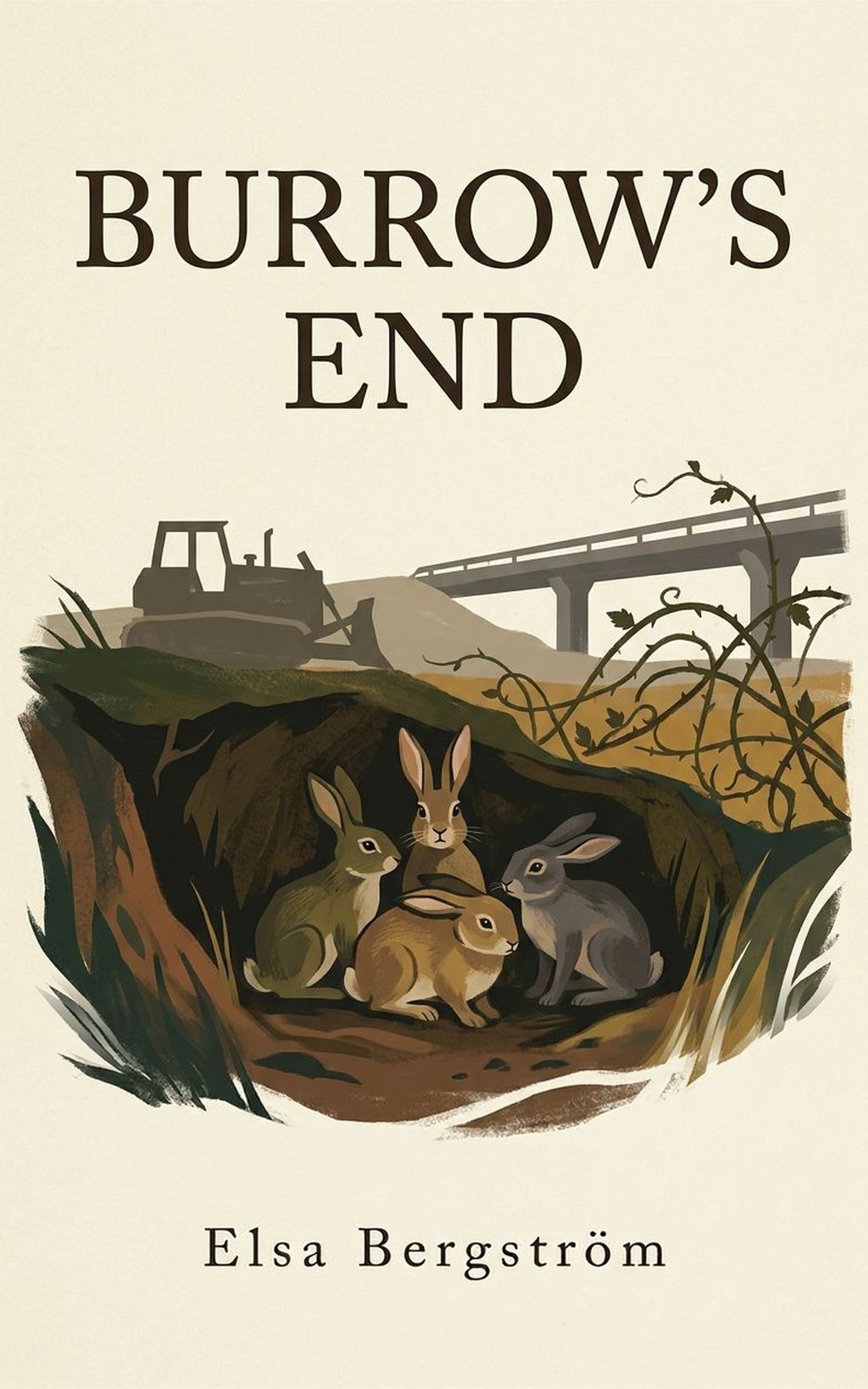
Burrow’s End is an animal adventure about home, courage and what safety costs. It is honest about danger and loss, as the great animal stories are, and some of its scenes are frightening. Here is what to expect, what to talk about, and a one-page guide for the classroom.
Age
For readers 10 and up, and for reading aloud from 9.
Length
38,875 words, about 160 pages: 37 chapters and an epilogue, in four parts
These notes say what kind of thing happens, never who it happens to.
Part OneChapters 1–8
The warren is destroyed to make way for a housing development. Many rabbits die in the collapse, among them the warren’s kindly old Elder. It is heard in the dark rather than seen, and kits are heard crying for their mothers. Chapter 8 is the hardest chapter of Part One.
Part TwoChapters 9–18
Chases by a fox and by farm dogs. Further deaths on the journey west, not graphic: they happen out of sight.
Part ThreeChapters 19–27
A frightening discovery, described closely.
Part FourChapters 28–37
A fight, heard more than seen, and the injuries it leaves, described plainly: blood, deep wounds and an infection.
Throughout
No profanity. The worst words are mild ones, like stupid and shut up.
Reading aloud to a younger child? Read a chapter ahead of them, and read Chapter 8 to yourself first. Part One is free on this site, so you can judge the tone before you begin.
Questions to talk about
Questions for each part, to use as you go. Parts One and Two give nothing away. The questions for Parts Three and Four do, so they wait under a lid until you have read the whole book.
Part One The World That Was
Chapters 1–8
Every morning Fern goes up first and thumps the all-clear for the warren. What does it take to be the one who goes first? Who goes first in your family?
Fern says: “I believe in what I can scout and what I can check and what I can thump to warn about. Everything else is a story.” Thistle believes the old stories. Which of them sees the danger more clearly when the orange flags appear?
Nettle maps the warren in signs: three rippling lines for water, a circle for a bolt hole, slashes for predator country. Draw a map of your home or your school his way. What would you mark as predator country?
When Fern tries to warn him about the flags, Elder Moss tells her: “Fear is a predator we carry inside us, and it kills more rabbits than foxes ever have.” Is he right? Why might a kind leader say something calming that turns out to be wrong?
Bracken has heard Thistle’s legend a hundred times, and still he leans forward to listen. Why do you think the warren loves to hear it again?
Chapter 8 tells the destruction through sounds more than sights. Why might the author have chosen to do that, and how did it feel to read?
Part Two The Crossing
Chapters 9–18
The band sets out west on the strength of a bedtime story. Is that brave, foolish, or both?
In the housing estate the band meets hutch rabbits who are fed, warm and safe, and who think life outside sounds terrible. Would you swap places with them? What would you gain, and what would you lose?
Fern admits to Bracken that she is scared. Can being frightened be useful? When has fear kept you safe?
At the motorway every rabbit’s gift matters: Nettle’s counting, Bracken’s nerve, Fern’s judgement. Who would you want beside you, and what would you bring?
The farm brings some of the book’s funniest moments, with Gerald the sheepdog, the hens and the barn cat. Why might a hard story need funny moments?
Thistle starts to doubt her stories when the woods and rivers she sang about turn out to have changed. What does Fern tell her a story is for? Do you agree?
Bracken holds the tunnel so that the others can get away. What does it cost him, and what does it give them?
Reed learned everything he knows about digging from Thorn. Can you keep what someone taught you and change what it is for?
The new warren has no sealed sections, no forbidden routes, a bolt hole from the first days, and a food store open to everyone. Why do those choices matter so much after Briar Hill?
Thistle says that true stories share one shape: you go out, you come back, and you are different. Is that the shape of this one? Of other stories you know?
Fern believes Thorn started with love, and that the control came later. Could that happen to anyone? How would you guard against it?
The book begins and ends with a morning scout. What has changed for Fern, and what has stayed the same?
Why do you think the book is called Burrow’s End?
Themes
Seven threads that run through the book, each with a line from it and a question to start with.
Home
Bramble Warren is chalk tunnels worn smooth by generations of fur, under one old hawthorn. The whole book asks what makes a place home.
What makes your home feel like home?
Displacement
The warren is lost to a housing development, and nobody asks the rabbits. The book is about what it is like to lose a home you never chose to leave.
Who loses their homes this way in our world?
Habitat loss
On the road west, a wood from Thistle’s songs has become a housing estate.
“The world changed. And nobody told us.”
What has changed in the places near you?
Leading while afraid
Fern leads because someone has to go first, not because she is fearless. Her brother tells her:
“Scared rabbits are alive rabbits.”
Can a frightened leader be a good one?
Stories as directions
Thistle’s bedtime legend is all the band has to steer by. Fern tells her:
“A story isn’t a lie just because the details are wrong. A story is a direction.”
Has a story ever pointed you somewhere?
Safety and freedom
The book keeps asking what safety is worth. Watching the hens in their pen, Fern says:
“Don’t admire the serenity of prisoners.”
Would you rather be safe or free? Must you choose?
Nettle
Nettle is the band’s mapmaker and its sharpest mind. The book never treats his leg as something to be fixed:
“His right hind leg was tucked beneath him at its characteristic angle — shorter than the left, twisted inward at the joint, a condition he had been born with and that he accommodated so naturally that it was simply how Nettle looked.”
How does the book let Nettle be so much more than his leg?
If you loved Watership Down, you will know this kind of story: rabbits who live as real rabbits do, a home lost to development, a hard road and the courage to keep going. Burrow’s End is shorter, set in the countryside of today, and written for readers from ten.
For the classroom
Ideas for a class or a reading group, all drawn from Part One, which everyone can read free here.
Nettle’s map. Map the school grounds in Nettle’s signs: rippling lines for water, circles for safe places, slashes for danger. Compare maps: who marked what, and why?
The morning scout. Write a dawn scout’s report on your street or garden, one sense at a time: what can you hear, smell, see and feel before anyone else is up?
Telling in threes. Thistle’s voice rises and falls in groups of three. Retell a family story or a local legend in threes, and hear how it changes the telling.
Then and now. Find an old map or photograph of your area and set it beside today’s. What has gone, what has arrived, and who lost a home?
What makes a leader? List what a good leader does, then test the list against Fern, Bracken and Elder Moss.
The one-page guide below leaves out Parts Three and Four, so pupils can have it before they reach the end.
To print the guide, use your browser’s Print command: this page prints as the one-page guide.
Reading it together
Burrow’s End
by Elsa Bergström. For readers 10 and up, and for reading aloud from 9. 38,875 words, about 160 pages, in four parts.
The story
Every dawn, Fern is the first rabbit above ground. She reads the night in the soil, checks the hedge gap and thumps the all-clear. She believes in what she can scout. Everything else is a story.
Then orange flags appear across the meadow, and the bulldozers come.
What to expect
Part One: the warren is destroyed by development; many rabbits die, heard rather than seen, and kits are heard crying (Chapter 8).
Part Two: chases by a fox and farm dogs; further deaths on the journey west, not graphic.
Part Three: a frightening discovery. Part Four: a fight; injuries described plainly, with blood.
No profanity.
Part One: talk about
What does it take to be the one who goes first, as Fern does every morning?
Fern trusts what she can scout; Thistle trusts the old stories. Who sees the danger more clearly?
Draw a map of your school in Nettle’s signs. What is your predator country?
Why does Chapter 8 tell the destruction through sounds more than sights?
Part Two: talk about
Is it brave or foolish to travel on the strength of a bedtime story?
Would you swap places with the safe, well-fed hutch rabbits?
Can being frightened be useful? When has fear kept you safe?
Why might a hard story need funny moments, like the farm?
Themes
Home
what makes a place home
Displacement
losing a home you never chose to leave
Habitat loss
a countryside changing under the travellers’ feet
Leading while afraid
going first, and being scared
Stories as directions
a story can point the way even when its details are wrong
Safety and freedom
what safety is worth
Nettle
a difference, not a problem
Try in class
Map the school grounds in Nettle’s signs: water, safe places, danger.
Write a dawn scout’s report on your street, one sense at a time.
Set an old map of your area beside today’s. What has gone?
Part One is free to read at the book’s website. The questions for Parts Three and Four give the story away, so they are on the website, under a lid, for when you have finished.